I’ve been thinking a lot about saving over the past couple of years. It’s not just about a job or a number in a spreadsheet, but about freedom, security, and our future.
When I look at the different ways to save, I always come back to the conclusion that mutual funds—especially broad, global equity funds—are the smartest and most effective form of saving for the long term.
Even so, there’s one more “form of saving” that should always be your top priority: paying off debt. And then there’s cryptocurrency, which I think is more of a speculative investment than something you’d include in a serious long-term savings plan.
Let me break it down for you, step-by-step, but don’t take my word for it.
Funds: It’s as easy as diversifying your portfolio.
It’s always been a great way to make money. Plus, it’ll help you stay safe from inflation.
What makes funds so powerful is how easy it is to own a small piece of the global economy. When you invest in a global index fund, you’re investing in thousands of companies across countries and industries. This gives you a level of diversification that’s impossible to achieve on your own.
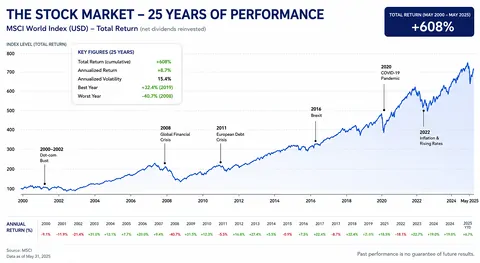
The stock market has historically offered an average annual return of around 7–10 percent over long periods (depending on the market and time frame), which is significantly higher than the returns you’d get in a standard savings account after inflation. Bank savings don’t usually do a great job of protecting your buying power when prices go up. But funds have actually been one of the best ways to counteract inflation over time.
The best thing about funds is that they require so little effort on your part. You can set up a fixed monthly savings plan—preferably through a stock savings account (ASK) to defer taxes. Then you let the money work for you through the compound interest effect. The longer the time horizon, the more magic happens. Ten, fifteen, and twenty years down the road, that difference really makes itself felt.
Of course, there are risks involved. The market’s always changing. There will be years of sharp declines, as we’ve seen several times. But for those with a time horizon of over 5–7 years (and preferably 10+), history has shown that patience pays off. People who try to time the market often end up losing. People who save regularly and stick to their plan tend to be the ones who end up winning.
Paying Down Loans: The safest “return” you can get.
I’m a big believer in mutual funds, but I’m also a realist. You can’t ignore debt. Paying off loans is also a great way to save money, especially for consumer debt or credit cards, but also for mortgages in many cases.
Why? It’s a guaranteed, risk-free “return” equal to the interest you save. If you pay down 100,000 kroner on a mortgage with a 5% interest rate, you’ll save 5,000 kroner in interest each year (before taxes). That’s money you never have to stress about losing in a stock market crash. It also gives you more financial freedom: lower monthly expenses, a better buffer against unexpected events, and less stress.
A lot of economists say that when your loan-to-value ratio is high (over 70–75 percent), it’s better to pay down a little extra before putting everything into funds. It’s all about finding the right balance. It’s usually best to mix it up a bit: pay off some debt, but also stash away some cash in a savings account. That way, you’ve got more than one way to skin a cat — both less debt and more money in the bank.
If you’re comfortable with low-interest rates and can handle some risk, it might be worth putting more money into these funds instead of focusing on paying off debt. But, of course, that means you have to be able to handle any dips without panicking and selling. Most of us would benefit from a little more security at first.
Cryptocurrency isn’t the best option for saving money over the long term.
Now, about cryptocurrency. I totally get it. It’s an exciting opportunity, and some folks have made good money. But for most people, I don’t think it’s the best choice for saving money over the long term.
Cryptocurrency is very volatile. Prices can change by 50–80 percent in a short time, both up and down. It’s more like speculation than saving. The Financial Supervisory Authority has been warning people not to use cryptocurrency to save their money because it’s too risky and doesn’t have the same value-creation potential as real companies that make goods and services.
With mutual funds, you own shares in companies that make money through innovation, sales, and growth. In the world of crypto, you’re often just holding a digital token whose value is all about demand, hype, and market sentiment. This can lead to some pretty big wins, but it can also result in some serious losses. When you’re looking to save for the long haul and want to be able to count on your investments, this type of risk isn’t ideal.
I see crypto as more of a “play fund” for those who can afford to lose it all and already have a solid savings plan in place. Not as the main way to save for a home, retirement, or your kids’ future.
Here’s some food for thought to wrap things up:
Saving isn’t just about getting the most out of your investments. It’s all about building a financial foundation that can handle life’s ups and downs and give you peace of mind. For most people, it’s best to save consistently in a variety of affordable funds and pay off debt in a smart way.
First, focus on getting rid of expensive debt. Try to save up 2–3 months’ worth of salary in your account. Then, set aside a fixed percentage of your income each month for savings. Just be patient. Don’t fall for the urge to chase quick gains.
It takes some discipline, but the payoff isn’t just money. You get more freedom and fewer worries over time. And I think that’s what really matters.
Sources: (Norwegian)These are general observations based on historical experience and common advice. Your personal finances are your own, so assess your own situation and feel free to contact an advisor at your bank.
- DNB. Avkastningsforventninger de neste 8–10 årene
- Finanstilsynet advarer forbrukere om kryptovaluta
- Finanstilsynet. Advarsel og faktaark om kryptoeiendeler
- Handelsbanken. Hva er renters rente og hvordan påvirker det sparingen din
- Nordea. Renters rente.
- Storebrand. Betale ned boliglån eller investere i aksjefond
- Hvor høy avkastning kan man over tid forvente ved sparing i aksjefond