
Photocure’s Innovative Products Hexvix, Cysview, and Cevira
In the world of cancer diagnostics and treatment, sometimes the smallest innovation can make the biggest difference. Photocure, a Norwegian specialty pharmaceutical company often called “The Bladder Cancer Company,” has built its reputation on photodynamic technology, a smart way of using light to highlight and treat abnormal cells.
Their flagship products, Hexvix® (used in Europe and most markets) and Cysview® (the U.S. and Canadian name for the same active ingredient), have transformed how doctors find and remove bladder cancer.
And with Cevira®, they’re now bringing that same light-activated approach to cervical precancerous lesions in a completely non-surgical way.
Let me walk you through these products in in a way that is easy to understand, with real-world examples of how they’re helping patients every day.
Hexvix® and Cysview®: Seeing Bladder Cancer That White Light Misses
Bladder cancer is one of the most common cancers, and it has a frustrating habit of coming back. The standard way to check the inside of the bladder is with a cystoscopy -a thin camera inserted through the urethra using ordinary white light. The problem? Many early tumors, especially flat “carcinoma in situ” (CIS) lesions, can hide in plain sight. They blend in with healthy tissue.
That’s where Hexvix and Cysview come in. About an hour before the procedure, the doctor instills a small amount of this special solution (hexaminolevulinate hydrochloride) into the bladder through a catheter. Cancer cells soak it up much more eagerly than healthy cells. When the doctor switches the cystoscope to blue light, those abnormal areas light up a vivid, glowing pink against the normal blue background. It’s like turning on a highlighter for cancer.
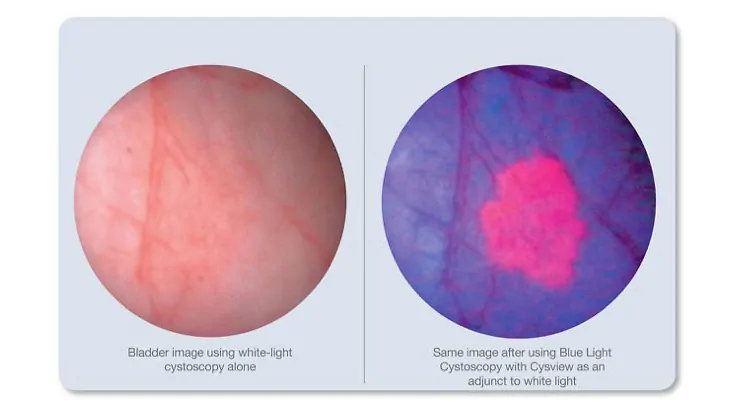
Comparison: It’s hard to find a white cat in the snow. If we paint the cat glowing pink, we’ll find it easily.
Clinical studies and real-world registries show this “blue light cystoscopy” (BLC) finds significantly more tumors than white light alone -sometimes 40% or more additional lesions. That means better removal during surgery, fewer recurrences, and better long-term outcomes for patients with non-muscle-invasive bladder cancer (NMIBC).
Real life examples
Here are some videos of people affected by bladder cancer. Listen to their stories
Photocure sells these products directly in the U.S. and Europe and works with partners worldwide. The technology is backed by decades of evidence and is now available with modern high-definition equipment for even sharper images.
Cevira®: A Gentle, Non-Surgical Way to Treat Cervical Precancer

While Hexvix/Cysview focus on detection, Cevira takes the photodynamic approach a step further into treatment -and for a different organ. It’s designed for women with high-grade squamous intraepithelial lesions, HSIL , also known as CIN2 or higher. These are precancerous changes on the cervix often caused by HPV. Traditionally, the standard treatment has been surgery (such as LEEP or cone biopsy) to remove the abnormal tissue.
That works, but it can carry risks like scarring, bleeding, or complications in future pregnancies.
Cevira is a drug-device combination that offers a first-in-class non-invasive alternative. A gynecologist applies a small amount of ointment containing the same light-sensitive ingredient used in Hexvix/Cysview directly to the cervix. Then a small, disposable LED device is gently placed on the cervix. The patient goes home, and after a few hours the device automatically turns on, delivering targeted red light for several hours. The patient simply removes the device afterward -no hospital stay, no stitches, and no disruption to daily life.
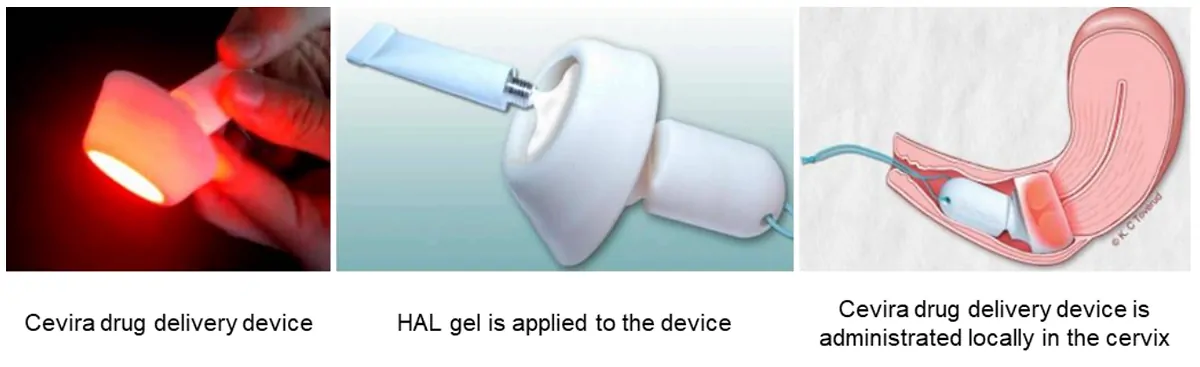
The light activates the drug, creating a reaction that destroys the abnormal HPV-affected cells while leaving healthy tissue largely untouched. Phase III studies have shown strong clearance rates for these lesions, including high-risk HPV types, with a favorable safety profile. It recently received approval in China as the first non-surgical option of its kind, and regulatory progress continues in other regions.
Why This Technology Matters
Photocure’s approach is elegant in its simplicity: it harnesses the body’s own chemistry and the power of light to make cancer easier to see or to destroy abnormal cells precisely. Hexvix and Cysview have already helped tens of thousands of bladder cancer patients worldwide get more accurate diagnoses and better treatment. Cevira is expanding that same principle to cervical health, giving women a gentler path forward.
Of course, these aren’t magic bullets -they’re tools used alongside standard care by skilled specialists. But they represent real progress: earlier detection, more complete treatment, and fewer invasive procedures when possible.
If you or someone you know is facing bladder cancer surveillance or has been told about cervical precancerous changes, talk to your doctor about whether blue light cystoscopy or emerging options like Cevira might be right for you. Innovations like these remind us that cancer care isn’t just about fighting disease -it’s about giving patients better quality of life along the way.
Photocure continues to invest in research, real-world evidence, and partnerships to bring these solutions to more people. Here’s to brighter futures, one pink-glowing cell at a time
How Photocure Makes Money from Hexvix/Cysview and Cevira
If you’ve read about Photocure’s cool light-activated technologies for bladder cancer and cervical precancer, you might wonder: “That’s great for patients -but how does the company actually turn this into a sustainable business?”
The short answer is Photocure earns money in two main ways, direct product sales (the big one today) and smart licensing deals that bring in milestones and ongoing royalties with very little extra effort on their part. It’s a classic biotech model: invest in innovation, then monetize through sales and partnerships.
1. Direct Sales of Hexvix® / Cysview® -Their Cash Engine
This is where most of Photocure’s revenue comes from right now. In 2025, Hexvix/Cysview product sales reached about NOK 530 million (roughly $48–50 million USD), up around 10% from the year before on a constant currency basis. That’s solid, steady growth.
How it works in practice: Photocure sells the Hexvix/Cysview solution (the fluorescent agent doctors instill into the bladder) directly in their key markets: the United States and Europe (especially the Nordics and larger countries like Germany).
In the U.S., they’ve built a strong commercial team and work closely with partners like ForTec to offer mobile blue-light cystoscopy towers. This lowers the barrier for hospitals -no need to buy expensive equipment upfront; they can rent the system as needed.
In Europe, they sell the kits and support new high-definition blue-light systems from partners like Olympus and Richard Wolf.
They also have distribution partners in places like Canada, Australia, New Zealand, Chile, and Israel.
Every time a urologist uses blue-light cystoscopy with their product, Photocure sells another kit. Higher usage in more hospitals = more recurring revenue. And because the gross margin on these kits is very high (often 90–95%), once they cover their sales, marketing, and operational costs, a large portion flows straight to profit.
They’re also pushing for broader adoption by:
Getting more accounts activated (they added dozens of new U.S. accounts in 2025).
Encouraging upgrades to better equipment.
Positioning blue-light as the smarter, more precise standard -especially as new bladder cancer drugs come to market and doctors need accurate staging.
In short: sell more kits, to more doctors, in more places, at good prices. Simple, but it works -and they’ve delivered positive commercial EBITDA for many quarters now.
2. Licensing Deals -Smart Partnerships That Pay Off
Photocure doesn’t try to do everything alone. For bigger or more distant markets, they license the products to strong local partners. This brings in money without Photocure having to build huge teams there.
For Hexvix in China:
They partnered with Asieris. Photocure supplies the product (and earns a markup), plus they get royalties on sales once it launches. China has a large bladder cancer population, so this could become meaningful over time. Regulatory steps for the blue-light equipment are still in progress, but early approval of Hexvix itself is a positive sign.
For Cevira® -The Big Upside Potential:
This is the classic “out-license and collect checks” story. Back in 2019, Photocure licensed worldwide rights for Cevira (their non-surgical treatment for cervical precancer) to Asieris.
The deal structure is attractive.
Upfront and development/regulatory milestone payments (tens of millions of USD possible across regions).
Double-digit royalties (10–20%) on future sales wherever Cevira is sold.
Additional milestones for new indications or approvals in the U.S. and Europe.
As of early 2026, Cevira received approval in China -the first market launch for this innovative non-invasive therapy. That likely triggered (or is about to trigger) milestone payments for Photocure. Asieris is building its commercial team there, focusing on fertility-preserving benefits for women.
Discussions with regulators in the U.S. and Europe are also moving forward, which could unlock even more milestones down the line. If Cevira becomes a success globally, those royalties could add a nice, high-margin revenue stream for years without Photocure bearing the full commercialization costs.
The Overall Picture
Today, Photocure is primarily a commercial-stage company focused on growing Hexvix/Cysview sales profitably in the U.S. and Europe while expanding access through mobile solutions and new equipment partners.
They have a healthy cash position and are generating operating leverage -meaning as sales grow, profits should grow faster because many costs are relatively fixed.
In the future, the licensing side (especially Cevira in China and potentially other markets, plus Hexvix expansion) should add more “passive” income through milestones and royalties. They’re also keeping an eye on adjacent opportunities in uro-oncology, like AI for blue-light imaging, to protect and extend their position.
It’s a balanced approach: control the core business where they have strong expertise and margins, while partnering smartly to reach more patients (and generate more revenue) elsewhere.
Photocure makes money by selling a high-margin diagnostic agent that improves cancer care, scaling that through direct efforts and partnerships, and collecting milestone + royalty payments as their licensed innovations reach the market. It’s not overnight riches, but it’s a thoughtful, growing business model built on real clinical value.
If you’re an investor or just curious about medtech, it’s a nice example of how innovation in diagnostics can create both patient benefit and long-term commercial success.
Sources:- Photocure and Asieris enter into a global licensing deal for Cevira®
- Asieris and Photocure enter into a license agreement for Cevira®
- Asieris: CEVIRA approved in China as first-in-class non-invasive therapy for cervical precancerous lesions
- Asieris’ CEVIRA® approved in China
- Asieris: Cevira endorsed with Level 1A evidence in expert consensus
- Photocure partner Asieris announces that EMA has accepted Marketing Authorization Application for Cevira in Europe
- Photocure partner Asieris
- Photocure ASA: Results for the fourth quarter and full year 2025
- Photocure ASA 4th quarter and full year 2025 results
- Photocure ASA. Our partners
- Photocure ASA. Investors hub
- Photocure: A licensing deal for Cevira
This post is based on my own interests and opinions. Nothing here should be interpreted as investment advice…. Never Ever!!