I’ve started thinking more about what life will be like when I retire. I want freedom – the chance to travel, spend time with family, and do things I enjoy, without having to worry about money.
For me, stocks have proven to be the smartest way to save over time. But not by buying and selling all the time. Quite the opposite.
Why I Stopped Following the Market Daily
I used to check stock prices on my phone app several times a day. Even minor news would prompt me to trade. I thought I was doing something smart, but it ended up causing more stress, higher costs, and worse results than if I’d just stayed calm.
Most people who trade frequently in the stock market don’t make more money in the long run. Often they lose, and feel they have to try to recoup those losses. That’s dangerous!
Here’s why it rarely pays to buy and sell frequently:
- Fees eat into your profits:
Every time you buy or sell, you have to pay fees. Over many years, this adds up to large sums. The less you trade, the more of your money you get to keep. - Tax on returns:
When you sell at a profit, you have to pay taxes. If you do this often, money that could have continued to grow disappears. If, on the other hand, you save for the long term, you can defer or reduce your tax liability. - Emotions ruin it:
We humans tend to buy when everything feels safe (i.e., when prices are high) and sell when things get scary (when prices fall). This is completely normal, but it leads to poor results. The best investors are often those who do the least. - Even the pros get it wrong:
Most people who work professionally with stocks fail to beat the market over time. So it’s unlikely that we ordinary savers will be able to do it by sitting at home and trading actively.
Frequent Buying and Selling in Mutual Funds
Many people believe that mutual funds are “safer” than individual stocks, and therefore it’s safe to trade more actively in funds. Unfortunately, this is not the case. When you trade mutual funds—that is, buy and sell fund shares frequently – you face the same challenges as with regular stock trading.
Every time you sell fund shares at a profit, you trigger a tax liability. In addition, you often pay a small subscription or redemption fee.
Even though the fees are lower than with direct stock trading, they still add up over time if you trade frequently. The money lost to fees and taxes is money that no longer gets to grow through compound interest.
In addition, emotions play a role in the same way. It’s easy to be tempted to sell when the market falls and “wait for better times,” or buy more when everything is going well. Most people who try to time the market through funds end up with worse results than those who simply save steadily and stay the course. Mutual funds are designed for long-term saving, not for day-to-day trading.
When buying equity funds, both purchases and sales often take several days, which makes funds completely unsuitable for speculation. On these days, a “sunny day” can quickly turn into “rainy weather” depending on the global outlook.
The best thing you can do with mutual funds is to choose one or more good, broad global funds, save a fixed amount every month, and leave them alone. That way, you take advantage of the market’s long-term uptrend without paying unnecessary fees or letting fear and greed drive your decisions.
Frequent buying and selling of individual stocks
Many people who start investing in stocks are tempted to buy and sell individual stocks frequently. It feels exciting to pick out “winning stocks” and try to sell before the price drops. But for most people, this quickly becomes an expensive hobby.
When you trade individual stocks frequently, you pay higher fees than with mutual funds, and every gain triggers immediate taxes. Over time, these costs eat into a large portion of your returns.
Additionally, individual stocks require much more knowledge and time, without necessarily yielding higher returns. A single company can run into trouble due to poor leadership, new competition, or unforeseen events. While a diversified fund spreads the risk across hundreds of companies, you can lose a lot from just a few bad choices. Most people who try to time the market with individual stocks end up with worse results than the market as a whole.
Emotions often take over – we hold onto losing stocks for too long and sell the winners too early.
Why this doesn’t work for retirement savings
For someone like me thinking about retirement, frequent trading in individual stocks is simply too risky. I want peace of mind and predictability, not stress over whether a single company delivers its quarterly report or not.
Recently, we had a discussion in the break room during lunch. A colleague and I discussed how we could find a strategy for buying stocks; here we use a stock as an example:
| Action | Buy & Hold | My tactic (Active) |
|---|---|---|
| Starting value | $8,630 USD | $8,630 USD |
| Day 1 (+3%) | Value: $8,889 USD | Value: $8,889 USD.I sell $259 USD. |
| Status on Day 1 | Stocks: $8,889 | Stocks: $8,630.Cash: $259. |
| Day 2 (-3%) | Value: $8,622 USD * | Stocks: $8,371.Cash: $259. |
| Repurchase | No trading. | I buy for $259. |
| Final value: | $8,622 USD | $8,630 USD |
*The math: $8,889 USD x 0.97 = $8,622 USD.
What does this tell us?
- The profit: By selling at the peak and buying at the bottom, I end up with $7,77 USD more than my colleague who did nothing (before costs). This is because I avoided the $259 losing value on day 2.
- The brokerage fee hit: To earn these $7,77 USD, I made two trades. If my broker (which is Nordnet, a local nordic broker) charges $8,52 USD in brokerage fees per trade, I paid $17 USD in fees to “save” $7,77 USD
- Result: I’m $9,23 USD in the red compared to doing absolutely nothing.
- The risk: If the stock had instead continued up 3% on day 2, I would have been sitting on cash on the sidelines and missed out on a new gain of $259 USD. Then my colleague would have crushed me.
The buy and sell amounts must therefore be somewhat higher than in the example – just to cover the brokerage fees. But that’s when the active style really gets scary.
What Actually Works
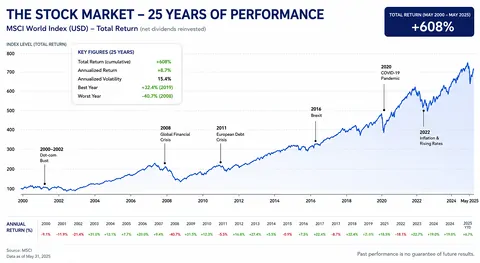
The stock market has historically delivered good growth over many years – around 7–10% per year on average. That might not sound like much, but over time the effect is significant because the money grows on its own (compound interest).
If you save $500 USD every month for 30 years with an average annual growth of 8%, it can amount to between $700 000 and $800 000 USD There’s a big difference between an ordinary pension and a really good pension.
- Choose broad funds that invest in many companies around the world (so-called global index funds)
Set aside a fixed amount each month - Let the money sit – don’t touch it during small fluctuations
- Increase your savings when you get a raise
Check and adjust your savings only once a year
Freedom lies in peace of mind
I don’t want to spend my retirement worrying about what happens to interest rates or stocks. I want to know that my savings are working for me while I live a good life.
The biggest benefit I’ve gained isn’t just the money – it’s the peace of mind. I sleep better at night, even when the market goes up and down.
If you’re also thinking about the future, start today. You don’t need to wait for the perfect time. Start with a small fixed amount. Small, boring, and disciplined choices almost always beat the exciting, impulsive ones. As little as $10 USD a month is a start.
– An ordinary wage earner looking forward to retirement
The content of this article is for informational purposes and personal reflections only, and should not be considered financial advice. Remember that market investments always involve risk.
Budget