We’re All Part of Something Shared, Just in Slightly Different Ways
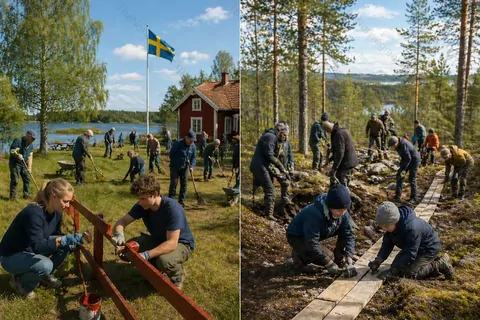
We Norwegians think of “dugnad” as our national pastime. That Saturday when everyone shows up with a thermos, tools, and a healthy dose of grumbling about the weather, to paint the garage or tidy up the cabin grounds. And yes—dugnad is quite unique in its Norwegian form. It’s almost like a sacred ritual. A friend from the U.S. called it “involuntary voluntary work” with a smile.
But we’re not the only ones in the Nordic region who step up when the community needs us.
Talkoot in Finland.
In Finland, it’s called “talkoot” (or “talko” in Finland-Swedish). It’s a lot like our dugnad: neighbors and friends team up to build a sauna, harvest potatoes, paint the woodshed, or clean up after a storm. The host usually provides food and drinks afterwards, so it’s sort of a given. “Talkoot” is a big deal in Finnish rural society.
Sweden, Denmark, and Iceland are all on the list.
In Sweden, they also use the word “talko,” but otherwise, people often talk about “gemensamt arbete” or volunteer work. Swedes are great at organizing community work parties in housing cooperatives and sports clubs, but it feels a bit more structured and a bit less spontaneous than here.
Denmark doesn’t have a fancy word for it, but they often call it “arbejdsfællesskab” or “fælles job.” The Danes really know how to make the most of their time—it’s not long before there are sausages on the grill and a great atmosphere once they get going.
In Iceland, volunteering is a big part of the small community. In small villages, people usually help each other out when there’s work to be done, like after a volcanic eruption or for festivals. Icelanders have a strong “we’re in this together” feeling.
What’s the difference?
In Norway and Finland, they’ve got some pretty strong, informal traditions. People there are expected to pitch in and not ask too many questions. Sweden and Denmark are a bit more organized and association-based. Iceland is pragmatic. When it’s needed, you just do it.
But there’s one thing that’s true for the whole Nordic region: We believe that small communities are most effective when people collaborate. It’s not just about getting things done. It’s all about getting to know each other, building trust, and having an excuse to hang out—preferably with coffee, buns, or something stronger afterwards.
In a time where everything is about efficiency and the individual, the Nordic spirit of community service is a small act of rebellion. It’s a good reminder that we’re better off working together.
Outside the Nordic Countries
Outside the Nordic countries, it’s not always easy to find a direct equivalent to our “dugnad.” But it does exist! In English-speaking countries, they talk about “barn-raising” or a “bee”—as in a “quilting bee” or a “husking bee.”
Imagine a group of neighbors gathering to build a house for a young couple or harvest corn together. It almost sounds romantic, until you realize that it often ends up with some people doing most of the work while the others eat most of the cake.
- In the U.S., they also have “work parties” in some circles, especially among those who live in the countryside or in alternative communities. But there’s often a hint of a service exchange involved: “I’ll help you with your garage this weekend, and you’ll fix my car next month.” A little less “we’re one big family” and a little more “neighborhood barter.” Still—when a hurricane sweeps through Florida, you suddenly see the true spirit of community service flare up. Then people show up without asking for payment.
- Further south, in Latin America, we find “minga” (in the Andean countries) or “mutirão” in Brazil. It’s community service with an extra kick and loud music. Here, entire villages often come together to build a school, repair a bridge, or plant coffee. The host doesn’t just provide food—it quickly turns into a party, with dancing and stories late into the night. The efficiency may be debatable, but the atmosphere? Unbeatable.
- In Japan, they have a tradition called “yui” or “moyai” on some islands—where the entire local community pitches in to help each other with rice farming or house building. This fits into Japanese culture, where the group is always more important than the individual. But be aware: there’s less loud complaining than at a Norwegian garage work party. Japanese volunteers only look slightly stressed for 0.3 seconds before smiling politely again.
- Even in more urban and individualistic societies like Germany and the Netherlands, we see that the spirit of community service lives on in housing cooperatives and “Eigenleistung” projects. Germans are, of course, a bit more rule-bound—there’s often an Excel sheet tracking who painted what and when. But once the grill is fired up afterward, they soften up considerably.
Ultimately, it may not be about the words “dugnad,” “talkoot,” or “minga.” It’s about the universal need to feel that we belong somewhere. That someone will miss you if you don’t show up with a thermos and a smile. In a world that’s becoming increasingly digital and lonely, these small, concrete actions are a kind of rebellion. Tangible proof that we (humans) still exist.
Have you ever been to a “dugnad/talkoot or minga” in another country?
Sources:- Norden. (2020). Voluntary work in the Nordic region
- Simon, C. (2019). Dugnad: A fact and a narrative of Norwegian prosocial behavior
- Visit Norway. Dugnad
- Wiki Aineeton kulttuuriperintö
- All Things Nordic. Dugnad
- BBC Worklife. How an ancient tradition shaped a nation’s work ethic
Cross-Cultural
