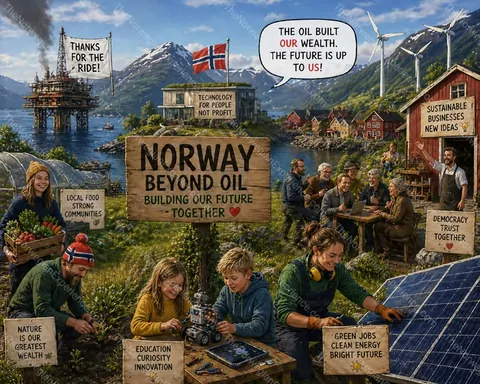
Norway After Oil: Thoughts on a Future We Must Shape Together.
As a country that has built one of the world’s most prosperous welfare states on oil and gas, Norway now stands at a historic turning point. Production on the Norwegian continental shelf has been a huge boon, raking in massive revenues, a sovereign wealth fund of over 20 trillion kroner, and a standard of living most nations can only dream of. But nothing lasts forever. Oil and gas production is expected to drop gradually by the end of this decade, and investments in the sector will likely peak in 2025–2026 before falling.
The question isn’t about if we have to adapt, but how we do it in a way that keeps everyone safe, creates new jobs, and keeps Norway competitive in a world that’s changing really fast.
This isn’t a crisis in the traditional sense, but an opportunity for reflection. The Oil Fund is like a safety net — it gives us some breathing room that other countries don’t have. But we can’t just rely on the returns. A sustainable economy needs to create value, not just consume the returns from the Fund.
What can replace oil?
Several sectors stand out as natural candidates for Norway’s future:
Renewable energy and the energy-intensive industry
Norway’s got a leg up on the competition when it comes to cheap, renewable electricity. This opens the door to attracting and developing energy-intensive, green industries—like hydrogen production, batteries, or low-emission process industries like aluminum and ferroalloys. Floating offshore wind is a really exciting area where the know-how from the oil and gas sector can be put to use.
Hydrogen and carbon capture and storage (CCS).
Green or blue hydrogen could become a new export commodity, particularly to Europe, which needs alternatives to Russian gas. CCS can help the petroleum industry last longer while cutting down on emissions.
Ocean-based industries:
The ocean has always been Norway’s domain. Aquaculture is already a success, but there’s room for more sustainable growth. Seafood, offshore wind, and maybe even seabed minerals could be good sources of new revenue—as long as we do them responsibly.
Knowledge in economy and technology
We’ve got solid research communities and companies in maritime technology, digitalization, and AI. The future is all about making research more commercially viable. We need to team up more between universities, institutes like SINTEF, and the business world.
Tourism, culture, and the experience economy
With its stunning natural beauty, safety, and solid infrastructure, Norway is an attractive destination for those who prioritize quality over quantity. But this needs to be balanced with environmental concerns.
We’ve got to face these challenges.
The transition isn’t without its risks. The oil and gas industry still employs tens of thousands of people directly and indirectly, especially along the coast. If we suddenly stop doing this without having other options, it could cause problems in certain areas. Investing in new industries is a long game. It can take 10–20 years from idea to profitable production.
We need stable framework conditions, good infrastructure, and a tax and regulatory structure that rewards risk-taking. The energy dilemma is real: Should we prioritize power exports, green industry at home, or rapid emissions cuts?
A thoughtful path forward
I don’t think there’s just one “solution” for what Norway should do after oil. It’ll be a mix of continued value creation from the petroleum sector during a transition period, new green ventures based on the ocean and power, and a stronger focus on knowledge and innovation.
The Oil Fund gives us a luxury that many countries envy—time to think long-term. This is going to take some maturity from politicians, the business community, and all of us. We’ve got to be willing to invest in the unknown, accept that not everything will work, and keep our eye on the ball as we strive to be a pioneer nation.
Norway has shown it can turn challenges into opportunities before. Now, we need to do it again, but this time we need to do it with wisdom and the belief that we still have a lot to offer the world.
The future isn’t something we just inherit; we build it.
Sources: (Norwegian)
- Norges Bank Investment Management. (2026). Oljefondets verdi
- Norwegian Offshore Directorate. (2026). Production forecasts
- Reuters. (2025, 14. august). Norway oil industry investment set to peak in 2025, survey finds. Yahoo Finance
- Reuters. (2026, 8. januar). Norway’s oil and gas output will fall towards 2030
- Statistisk sentralbyrå / Norwegian Offshore Directorate
- Teknologirådet. Luksusfellen – omstilling i en oljeøkonomi