Status Report: May 13, 2026
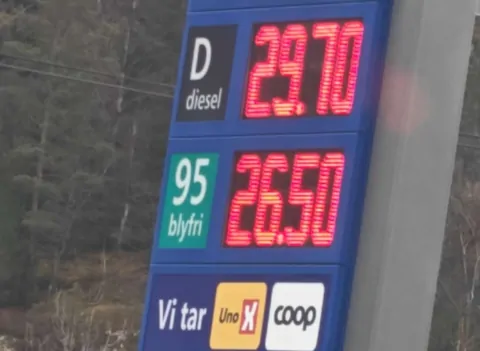
There is little that concerns us Norwegians more than the price of gasoline and diesel. But here we are in May 2026, and the discussion has taken on a new and more urgent tone. Now that pump prices are regularly exceeding 22 and 23 kroner per liter as the new normal, the same question is surfacing with renewed intensity: Why is it so expensive here at home – in a country that remains one of the world’s largest energy producers?
We have left years of debate behind us, but the figures we see around us, now demand that we put things into an honest perspective.
Norway among the most expensive in Europe
In Norway, the average price of 95-octane gasoline in April 2026 typically ranges between 19 and 23 kroner per liter, depending on the station, time of day, and any temporary tax cuts. Diesel is often in the same range or slightly higher, around 20–24 kroner per liter.
In euros, this corresponds to approximately €1.95–2.10 per liter for gasoline. This places Norway at the very top among the most expensive countries in Europe, alongside Sweden, Denmark, and the Netherlands.
By comparison, the EU average for Euro 95 is around €1.76–1.87 per liter, while diesel is around €1.94–2.08. The cheapest countries are found in Eastern Europe and Malta, where gasoline can cost less than €1.40 per liter. In Poland or Hungary, drivers often pay 30–40 percent less than in Norway.
USA – a whole different world
While here at home we have seen prices stabilize in the 20s in 2026, the contrast with the USA remains enormous.
The national average price for regular unleaded gasoline in April 2026 is around $4.00–$4.15 per gallon. Converted to liters and Norwegian kroner, that comes to approximately 9–11 kroner per liter – roughly half of what we pay here at home.
Diesel is also significantly cheaper in the U.S. than in Europe. While Europeans pay nearly 60 percent more for diesel than Americans on average, the gap with Norway is even wider.
What drives the high Norwegian prices?
The price of crude oil is a key factor, and it has been influenced by unrest in the Middle East. But that explains only part of the price. In Norway, taxes and VAT typically account for 50–60 percent of the pump price of gasoline and diesel.
These include:
- Road usage tax
- CO₂ tax
- Value-added tax (25%)
These taxes are intended to finance roads and transportation and reduce emissions through the pricing of greenhouse gases. The policy is clear – it should be worthwhile to choose more environmentally friendly alternatives.
At the same time, much of Norway’s oil is refined abroad, so we import finished gasoline and diesel back into the country. In March/April 2026, the government temporarily cut some taxes to ease the burden, but Norway still ranks high internationally.
What does this mean for us?
For many Norwegians, especially those in rural areas and those who rely on cars for work, high fuel prices are a real burden. Companies in the transportation, fishing, and construction sectors feel this particularly acutely.
At the same time, the high prices are helping to accelerate the shift toward electric vehicles – an area where Norway is already a global leader.
But this also raises a fundamental question: How high should taxes be before they hit ordinary people and businesses too hard? And is it fair that an oil-producing country like Norway has some of Europe’s highest fuel prices?
The Future – Will Prices Just Keep Rising?
Starting in 2027/2028, new EU regulations (ETS2) could make fuel even more expensive by including a larger portion of the transportation sector in the emissions trading system. Analysts warn that the price per liter could rise further unless the tax system is adjusted.
At the same time, we see that several countries in Europe are considering temporary relief measures when prices get too high. Norway has already done so once this year.
Nevertheless, it is worth remembering that high fuel prices do not affect everyone equally. Those who live in cities and have already switched to electric cars hardly notice anything. For them, the policy has worked as planned. But for those who drive long distances, commute from rural areas, or work in industries that will require fossil fuels for many years to come, it feels more like a punishment than an environmental tax. The gap between urban centers vs. rural districts is only becoming more pronounced.
The Oil Nation That Fleeces Its Own?
The irony, of course, is that we sit on enormous oil and gas revenues. Some of the money goes back to the general public through lower taxes, generous welfare programs, and the Oil Fund. Yet for many, it feels as though the state takes a lot with one hand and gives back with the other – only what is given back doesn’t always reach those who need it most. If a larger portion of oil revenues had gone directly toward lowering taxes on essential goods like fuel and electricity, the debate would have been less heated.
At the same time, we must be honest: Without high taxes, we would likely have seen even more cars on the roads and a slower transition. After all, Norway has the world’s highest density of electric cars, and that is no coincidence. Pricing has been one of the most powerful tools. The question is simply whether we have found the right balance, or whether we have overshot the mark in an effort to demonstrate decisiveness.
Between greed and climate goals
Another point rarely mentioned in the debate is that Norwegian refineries and fuel chains enjoy healthy margins. When the price of crude oil goes up, the pump price rises quickly. When it goes down, it falls far more reluctantly. Combined with government taxes, this creates a price dynamic that means Norwegians pay some of the highest prices in the world—even when the oil is “ours.”
Ultimately, it comes down to priorities. Do we want cheaper fuel in the short term, or are we willing to pay a high price to force the transition to a zero-emission society? We cannot have both at the same time. As an observer of the Norwegian economy, I am struck by how dishonest the debate often is. It is either portrayed as pure greed on the part of the government, or as necessary climate action without sacrifice. The truth lies somewhere in between – and that is where most Norwegians actually stand.
As we now look back on the past few years from our vantage point here in 2026, we see that the transition has come at a cost. The question is: What happens as we approach 2030? Should we lower taxes more permanently, or is it right to use pricing as a climate measure?
Sources:- European Commission. (2026, April). Weekly oil bulletin
- Eurostat. Significant increase in fuel prices in March 2026
- Finansdepartementet. Oppfølging av Stortingets vedtak om reduksjon i avgifter på drivstoff
- GlobalPetrolPrices.com. Norge – bensinpriser
- GlobalPetrolPrices.com. Gasoline prices in Europe
- U.S. Energy Information Administration
- AAA Gas Prices. National average gas prices
- Fuel-prices.eu.Fuel prices in Europe
Cross-Cultural Budget Nor2050