
We often hear that Norwegians have a unique work life. But what does an ordinary Tuesday actually look like? How does our cup of coffee in Norway compare to a desk in New York or a factory in Germany?
The 7:00 a.m. Club: The People Who Build the Country
In Norway, we have a strong tradition of early shifts. Construction, manufacturing, and much of the healthcare sector often start at 7:00 a.m., meaning the workday ends by 3:00 p.m.
This 7–3 rhythm is deeply rooted in Norwegian logistics. It’s about making the most of the daylight hours and getting the most out of the afternoon. While office workers might clock in at 8:30 a.m., tradespeople have already been hard at work for several hours. This rhythm gets society up and running early, but it also means that we value free time and daylight more than people in most other countries do.
Do we actually work less?
When we look at the statistics, we see clear differences in how much time we spend at work over the course of a year.- Norway: The average number of working hours is approximately 1,425 per year. This is among the lowest in the world.
- The USA: The average American worker puts in about 1,811 hours per year—nearly 400 hours more than the average Norwegian worker.
- Europe: Germany has an average of about 1,340 hours, which is lower than Norway’s average. Meanwhile, countries in Eastern Europe often approach the American average.
Despite working fewer hours, Norway’s hourly productivity is among the highest in the world. We simply get more done when we’re at work.
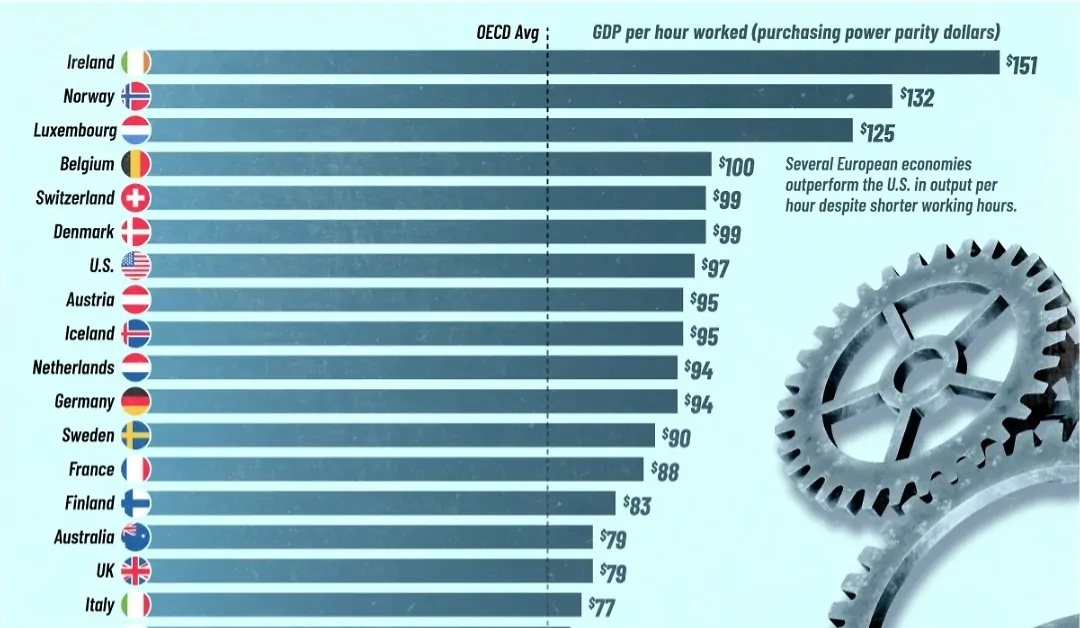
Norway vs. the U.S.: Two Worlds, Two Philosophies
- Trust vs. Control: In Norway, management is based on trust. The boss expects you to do your job without supervision. In the U.S., control is stricter, and many employees feel pressured to be physically present to prove their worth.
- Wages and Security: In Norway, collective bargaining agreements ensure a decent wage for everyone. In the US, however, the wage gap is enormous, and the lack of a safety net means that many people don’t dare take vacation, even though they are entitled to it.
- Protection against dismissal: In Norway, it is difficult to lose your job without just cause. In the U.S., there is a culture characterized by greater uncertainty and obedience.
Working from home and overtime
Since the pandemic, working from home has become a regular part of everyday life in Norway. While Norwegian managers generally trust their employees, many American companies have implemented strict monitoring policies or forced their employees to return to the office.
Perhaps the greatest difference is in how overtime is handled:- In Norway, overtime is an exception that must be compensated or taken as time off.
- In the U.S., however, overtime is often expected in professional careers, and being always online is seen as a status symbol.
Summary: Pros and Cons
Advantages of the Norwegian model:
- Extremely good work-life balance.
- High degree of autonomy and trust.
- Security through strong rights and protection against dismissal.
Disadvantages of the Norwegian model:
- It can be difficult to reach people after 4:00 p.m., although most will step up if needed.
- Decision-making processes can take time because everyone must be heard.
- High costs for businesses mean we must be extremely efficient.
Conclusion:
The Norwegian workday is all about making a simple trade-off. Work hard and efficiently while you’re at work, and leave work behind when you leave. We have built a society where trust replaces control and leisure time is an investment in good health.
While the U.S. focuses on individual success and long workdays, Norway has found a happy medium. We may start early, but in return, we have a life outside of work that few other countries can match.
Sources:- Visual Capitalist – Global Productivity
- Regjeringen.no – Arbeidsmiljøloven
- Arbeidstilsynet
- SSB (Statistisk sentralbyrå):
- NHH Bulletin – Lederstil
- Westlaw – US vs. EU Employment Law
Cross-Cultural