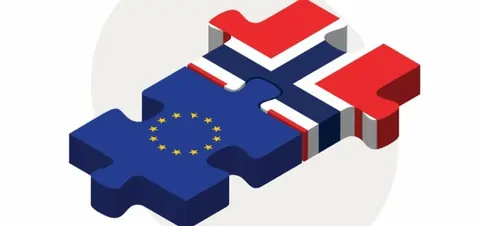
For over 32 years, the EEA Agreement has been the backbone of Norway’s relationship with Europe. Originally intended as a temporary solution after Norwegian voters rejected EU membership in 1994 (under Gro Harlem Brundtland), the agreement was signed in 1992 and entered into force on January 1, 1994. Today, however, it is anything but temporary. The agreement has shaped the Norwegian economy, labor market, public administration, and legal practice more than any other agreement in modern times.
What exactly is the EEA Agreement?
EEA stands for the European Economic Area. The agreement includes the EU’s 27 member states, as well as Norway, Iceland, and Liechtenstein—a total of 30 countries and approximately 450 million people. At its core are the freedoms of movement of goods, services, capital, and people.
Through the EEA, Norway has gained full access to the EU’s single market without being a member of the union. In return, Norway commits to incorporating and implementing many of the EU’s regulations related to the single market, including product standards, competition rules, consumer protection, environmental requirements, and labor law.
The agreement is dynamic. New EU legal acts (legally binding documents) relevant to the EEA are assessed and often incorporated via the EEA Committee. Since 1994, tens of thousands of these legal acts have become part of Norwegian law.
How does the agreement work in practice?
In theory, Norway has a veto right in the EEA Committee. In practice, however, it is almost never used because exercising a veto could jeopardize market access entirely. Norway does not participate in EU decision-making processes—it has no voting rights in the Council of Ministers, no representatives in the European Parliament, and limited influence early in the process.
Although Norwegian authorities and courts have developed solid practices for handling EEA law, cases such as the NAV scandal have shown that challenges can arise when EEA rules encounter Norwegian administrative culture. The courts must balance national legal traditions with the faithful implementation of common European rules.
As of January 2026, a record-high 661 EEA-relevant legal acts were pending in the EEA Committee. However, the implementation backlog for directives has been reduced to 0.7%, which is among the best in the EEA area.
Switzerland — a different path to the same goal?
While Norway opted for the EEA model, Switzerland pursued an alternative approach. In a 1992 referendum, Switzerland rejected the EEA and has since developed its relationship with the EU through a series of bilateral agreements—approximately 120 sector-specific agreements in total (Bilateral I and II).
This “Swiss model” has long served as an alternative example in the Norwegian debate. It provides access to large parts of the single market without the same obligations as the EEA and gives Switzerland flexibility in specific areas.
In March 2026, the EU and Switzerland signed a new, comprehensive package of agreements often referred to as “Bilateral III” or the “Switzerland–EU package.” On March 2, 2026, European Commission President Ursula von der Leyen and Swiss President Guy Parmelin signed the package. The package modernizes existing agreements, expands cooperation to new areas such as electricity, health, food safety, and research programs, and introduces more dynamic mechanisms for updating regulations.
The package is currently undergoing the ratification process in both Switzerland and the EU and may be subject to a referendum in Switzerland.
Comparison between the EEA and the Swiss model
- Scope: The EEA comprehensively covers nearly the entire internal market. The Swiss model is more sector-specific, though Bilateral Agreements III expand its scope significantly.
- Dynamics: The EEA is automatic and dynamic. The new Swiss package has dynamic elements, but not to the same extent.
- Dispute Resolution and Oversight: Norway has the EFTA Court and ESA. Switzerland has mechanisms involving more mediation and the involvement of the European Court of Justice in certain areas.
- Influence and Sovereignty: Both countries adopt much of the EU’s regulatory framework without voting rights. However, Switzerland has traditionally argued for greater national leeway in certain fields.
Many in Norway have looked to Switzerland as a potentially “lighter” alternative involving less surrender of sovereignty. At the same time, however, experience shows that Switzerland is also undergoing a form of “Europeanization.”
Benefits and Challenges
The EEA has provided Norway with stable and predictable access to the world’s largest single market, which is invaluable for exporting oil, gas, fish, and other goods and services. Norwegian citizens enjoy freedom of movement, and businesses enjoy a level playing field.
However, critics point out that Norway adopts regulations without being involved in shaping them, which challenges its sovereignty. This is particularly true for the labor market, the environment, and the public sector. The debate over the EEA lag and the pace of incorporation shows that striking a balance between flexibility and commitment is not easy.
Compared to Switzerland, Norway is more closely integrated, while the Swiss have negotiated more tailored solutions — even though they are now moving toward a closer, more binding framework.
This will be particularly relevant in climate and energy policy in 2026. Through the EEA, Norway must address the EU’s Green Deal, emissions trading, carbon pricing, and renewable energy requirements, as must Switzerland through the new package.
Where will we stand in 2026?
The EEA Agreement remains the political reality for Norway. While it has provided economic security in a turbulent world, it requires constant attention. The new Swiss agreement package shows that the EU prefers stable, predictable frameworks, whether through the EEA or modernized bilateral agreements.
Many are asking: Does the EEA still offer Norway the best balance between market access and independence? Or might the updated Swiss model inspire a broader debate on future alternatives?
Regardless of one’s viewpoint, one thing is certain: The EEA and Swiss agreements are both far more than technical trade agreements. They are integral parts of society and the legal order that affect businesses, workers, and consumers every day.
Is the EEA Agreement still the right solution for Norway, or should we examine how Switzerland navigates its relationship with the EU?
Sources:- EFTA Surveillance Authority. (2026, januar 30). Internal Market Scoreboard: Transposition of directives improves in Iceland and Norway
- Regjeringen.no. (2026, mars 21). Nye rettsakter i EØS-avtalen 20. mars
- Stortinget. (2026, februar 4). Lavere gjennomføringsetterslep i Norge. EU/EØS-nytt
- Dagsavisen. (2026, februar 4). EØS-etterslepet overgår rekord fra 2021.
- European External Action Service. (2026, mars 2). EU and Switzerland sign broad package of agreements
- Federal Department of Foreign Affairs (EDA). (2026, april 22).
- Aftenposten. EØS-avtalen blir utvidet med nesten 90 nye regler
Cross-Cultural Nor2050