Why Nuclear Power Is Norway’s Best Shot at Meeting Its Climate Goals -Without Crushing Household Electricity Bills
Norway has some of the most ambitious climate targets in Europe: 55 % greenhouse-gas cuts by 2030 and net-zero by 2050.
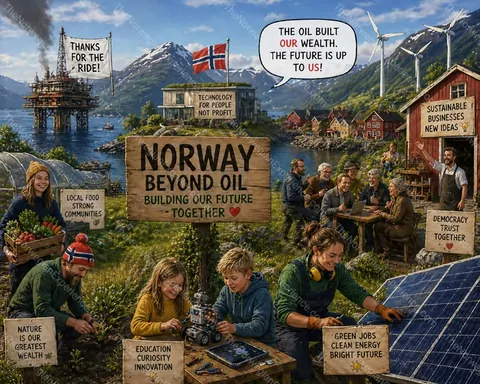
The single biggest lever for hitting those numbers is electrifying the offshore oil and gas platforms that still dot the North Sea.
Today those platforms burn their own natural gas to generate power -a process that emits roughly 4–5 million tonnes of CO₂ a year just on the Norwegian Continental Shelf. Hook them up to shore power and you slash those emissions overnight.
The problem is simple math.
The Norwegian Water Resources and Energy Directorate (NVE) estimates that full electrification of the shelf will require an extra 15–20 TWh of electricity per year by 2040 -roughly the output of four or five large gas-fired plants, or the equivalent of adding another 30–40 % to current national consumption. At the same time, we’re pushing millions of electric cars, building data centers, and expanding green hydrogen production.
Hydropower, Norway’s historic pride and joy, is already maxed out in most places. New large-scale hydro is politically and environmentally dead. Onshore wind faces local resistance and grid bottlenecks. Offshore wind is coming, but it’s expensive, intermittent, and years away at scale.
That leaves a gap that only firm, dispatchable, low-carbon baseload can fill. Nuclear power is the obvious candidate.
I realize the word still makes some Norwegians instinctively reach for the “Chernobyl” file. Fair enough. I grew up in the American Midwest in the 1980s; Three Mile Island was drilled into us too. But the technology on the table today is not 1970s-era reactors.
Small modular reactors (SMRs) and Generation IV designs are factory-built, passively safe, and can be sited near existing grid connections with far smaller footprints.
Countries like Canada, Sweden, and even parts of the U.S. are moving forward precisely because they’ve done the risk math: modern nuclear has the lowest death-per-terawatt-hour record of any energy source, including wind and solar when you count the full lifecycle.
For Norway, the advantages are almost tailor-made
- Reliability for offshore electrification. Platforms need power 24/7, winter and summer. A nuclear plant doesn’t care if it’s dark in January or if the wind dies down.
- Price stability for Norwegian households. Electricity prices here have swung wildly the last few years -remember the 2022 spike that had families choosing between heating and groceries? More supply, especially firm supply that doesn’t depend on spot-market gas prices in Europe, is the single best tool for keeping long-term prices predictable.
Nuclear plants have high upfront costs but very low operating costs once running; the math works out to stable bills for decades.
- Industrial competitiveness. Equinor and the supply chain companies that employ hundreds of thousands of Norwegians can keep operating while cutting emissions. That preserves jobs and tax revenue that pay for the welfare state everyone here values.
I’m not suggesting we bulldoze the landscape with giant cooling towers. The newest SMR concepts can be built underground or in existing industrial zones. Norway already has world-class engineering talent, strict safety culture, and the regulatory expertise that turned offshore oil into a global model. Applying that same rigor to nuclear is not a leap; it’s an extension of what this country already does exceptionally well.
The alternative is less comfortable.
We can keep importing power from the Continent during dry years, but that means importing someone else’s emissions and volatility.
We can double down on intermittent renewables and accept that households and industry will pay the price in the form of curtailment, expensive batteries, and transmission upgrades. Or we can have an honest, evidence-based conversation about adding nuclear to the mix.
I’m an American who chose to make Norway his home. I care about the climate targets my kids will inherit, and I care about the electricity bill my family pays every month. The data says nuclear is the pragmatic bridge that lets us hit both goals at once.
It’s time Norway -pragmatic, engineering-minded, future-focused Norway -stopped treating nuclear as a political third rail and started treating it as the engineering solution it is.
The future of the North Sea platforms, the affordability of Norwegian homes, and the credibility of our climate leadership all point in the same direction. It’s time to flip the swittch!
Sources:- DNV. (2025). Energy transition outlook Norway
- Norwegian Offshore Directorate
- Offshore Norge
- Our World in Data. (2020). What are the safest and cleanest sources of energy
- Ritchie, H. (2020). Safest sources of energy. Our World in Data
- The Norwegian Government. (2021). Norway’s climate action plan for 2021–2030
Nor2050