The Law of Jante, Dugnad, and the Never-Ending Search for Norwegian Friends – A Love Guide for Beginners
Welcome to Norway! Here, the weather is cold, but the people are warm—just not in the way Europeans and Americans take for granted. No, here you have to put in a little effort. And it often starts with understanding two of the most Norwegian things there are: “Janteloven” and “dugnad.” Once you figure those out, the path to true friendship is suddenly much shorter than you think.
The Law of Jante—the invisible protective vest
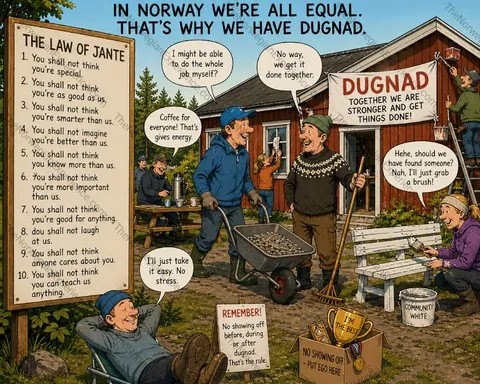
Most people have heard of it. It comes from Aksel Sandemose’s 1933 novel, where the fictional town of “Jante” had ten commandments that, in practice, said one thing: “You shall not think you are any better than us.”
These days, the Law of Jante isn’t so much a law as it is a cultural reflex. Most Norwegians aren’t big on bragging. We tend to be a bit skeptical of people who stand out from the crowd—or at least of those who do so in a very obvious way.
That’s why you rarely hear a Norwegian say “I’m absolutely fantastic at my job!” even though they exist. Instead, you get a humble “It’s going okay,” even if the person has just saved the whole project by themselves.
You could put it this way with a playful smile: The Jante Law is the Norwegian way of keeping the ego in check. It keeps us grounded, but it can also make it a bit tricky to accept compliments without feeling a bit embarrassed. So, if you praise a Norwegian, be prepared for them to look down at the floor and mumble something like “it wasn’t anything special.”
The point? Don’t take it personally. It’s not you. It’s Jante.
Dugnad is Norway’s best team-building experience, and it’s all done without PowerPoint.
While the Jante Law is about blending in, “dugnad” is about stepping up and contributing.
Dugnad is a Norwegian concept where people come together voluntarily (well, almost voluntarily) to do something useful together, without getting paid. Painting the fence in the housing cooperative, cleaning up at school, or building a new playground. It’s all about equality in practice: No one’s too good to hold a broom, and no one’s too lazy to show up.
Dugnad is actually a great way to bring people together. Here, it’s not about you or your career. You talk about paint, the weather, and just how heavy that old sofa in the basement really was. And while you’re standing there with your own hammer, broom, or paintbrush, something magical happens: People chill out. They laugh a little. They share coffee from a thermos. Out of the blue, you’re no longer “the new guy,” but “the one who showed up for the community work day.”
Here are some tips from someone who’s been to a lot: Bring something good to drink or eat. The Norwegians really like it. And don’t be afraid to ask for help or crack a joke. Community work days can be a mix of hard work and good-natured fun.
So, how do you actually become friends with Norwegians?
Here’s a pretty honest, slightly sarcastic, but super practical, guide. Put on your hiking boots, because now we’re heading out into the field:
- Start with a shared activity—avoid small talk. Norwegians aren’t really into small talk on the tram. But put us together with a common goal—like community work, a hiking group, a choir, soccer, or volunteer work—and we’ll thaw like snow in May. First things first: get the activity going, then move on to the real conversation.
- Be patient—this is a marathon, not a sprint. Friendships here take time. You won’t become best friends after one beer. It can take months or years before “Hi, nice to meet you” turns into “Shall we go to the cabin together?” Relax. It’s totally normal. Don’t stress, just be there consistently.
- If you can speak Norwegian at all, even if it’s a little rusty, that would be great. Norwegians often switch to English to be polite, but that can make things seem more distant. Make sure you practice your Norwegian. Most people really appreciate the effort, and suddenly doors open as if by magic.
- Brag smartly by using self-deprecating humor. The Jante Law is still going strong. Feel free to talk about the things you’re proud of, but add a bit of humor to make it more interesting: “I managed to fix the washing machine on my own—a miracle!” is way better than “I’m pretty handy, I must say.”
- Invite them to something simple and authentic to Norway. “Shall we grab a coffee?” is fine. But “Shall we go for a walk in the woods on Sunday?” is my favorite. Nature is Norwegians’ third-best friend (right after coffee and family). Fresh air and exercise are a great icebreaker.
- Show that you’re part of the team. Come out for the community work day. Help with the dishes after dinner. These small signs that you understand the community spirit count for more than you realize—and people notice them.
And remember: Even though Norwegians might seem like a bunch of reserved mountain goats at first, most of us are actually pretty easy to get to know. We just ask that you show you’re willing to join the team without demanding star status right away.
It’s almost a bit like dating, just without the awkward compliments about eyes and smiles. Instead, it’s about showing up in woolen underwear and a raincoat at nine o’clock on a Saturday to paint a fence, and still finding it cozy. If you can manage that without complaining too much, you’re already halfway into the hearts of both your neighbor and the housing association.
Don’t give up if it takes time. Some of the best Norwegian friendships I’ve seen have started with a failed small talk on the tram and ended with sharing a cabin, a boat, and secret cookie recipes ten years later.
It’s a slow, slightly bumpy, but incredibly solid love story. So bring the coffee, bring your good humor, and feel free to bring a joke in broken Norwegian. We’ll laugh with you—not at you. Well, almost.. always.
At last!
Norway’s not a tough place to live, but there are some unwritten rules you’ve got to learn. The Jante Law teaches us humility, community work teaches us solidarity, and the friendships that grow from there are often genuine, stable, and free of drama.
So, next time the housing association asks for volunteers for a community work day: Say yes. Don’t forget to bring a thermos. Try smiling a little. And don’t forget that beneath all the casual “it’s fine“s, there are warm, funny, and loyal people just waiting for you to show that you’re down to be part of the team.
Welcome to the gang! And remember: Don’t think you’re anything special, but don’t think you’re nothing either. That’s basically the modern, slightly more grown-up version of Jante Law.
Have a blast at the community work day, and good luck making new friends!