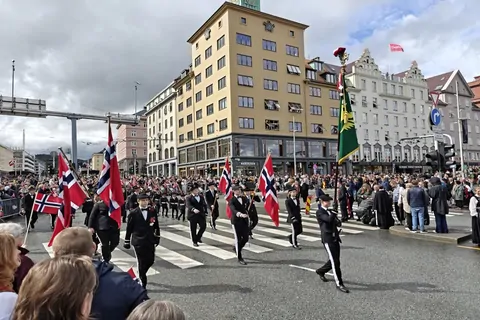
May 17 isn’t just a national holiday—it’s a celebration full of joy, tradition, and a bit of controlled chaos. Imagine a mix of national pride, a big day for the kids, and a huge family party – all wrapped up in “bunads”, flags, and wieners. Welcome to our version of Independence Day, just without the fireworks and with a lot more ice cream.
What are we actually celebrating?
On May 17, 1814, we signed Norway’s Constitution at Eidsvoll. It wasn’t full independence, but the start of something big. That’s why we call it “Grunnlovsdag” – a celebration of freedom, democracy, and rights.
Unlike in many other countries, May 17 is surprisingly low-key when it comes to military and political aspects. It is first and foremost a day for children. While many national holidays revolve around soldiers and parades with cannons and gunpowder, ours is about thousands of children marching through the streets with flags, music, and big smiles.
What a typical May 17 looks like
The day often starts early. Many people put on a “bunad” – the beautiful, handmade traditional costume that varies from region to region. If you don’t have a “bunad,” it’s perfectly fine to wear nice, everyday clothes – preferably with a red, white, and blue bow.
The music: The “Korps”
No May 17th is complete without the sound of drums and trumpets echoing between the walls of houses. Even before most people have rubbed the sleep from their eyes, school bands march through the streets to wake up the neighborhood. There is something truly special about the sight of children and young people in crisp uniforms carrying heavy instruments with great pride. Even if they might hit the odd wrong note after marching for many kilometers, it is precisely this music that gives every Norwegian that tingling feeling in the stomach. It is the sound of freedom, community, and a good dose of enthusiasm.
Then the “barnetogene” (childrens parades) begin. Across the country, school classes march through downtown while “korps” play, people cheer, and flags are waved. In Oslo, the big children’s parade passes by the palace, where the royal family stands on the balcony waving.
After the parade, there are games, speeches, and food. Parks and schoolyards fill up with happy children (and tired adults) enjoying hot dogs, ice cream, and strawberries with whipped cream.
You’ll see grown men in “bunad” chasing after children with balloons, and grandmothers handing out chocolate while discussing the weather. It’s national pride without taking itself too seriously.
Food, traditions, and fun
Once the big parades are over, the party often moves to the local schools. Here you’ll see the Norwegian “dugnadsånden” in full bloom. Parents in bunad stand at the concession stand selling cakes, while the kids compete in sack races, potato races, and the wheel of fortune. This is where the unofficial world records for ice cream eating are set. It’s informal, it’s noisy, and this is where you really see how the entire local community comes together to create an unforgettable day for the children. Remember to have small change or “Vipps” ready – you’ll spend a few kroner on raffle tickets and cakes!
The classics are:
- Sausage in “lompe” or bread with lots of mustard and ketchup
- Ice cream (often with long lines of people)
- Strawberries and cream
- Open-faced sandwiches, “spekemat”, and cakes at home or in the garden. “Rømmegrøt” is also a classic.
Many families have traditions like having breakfast outdoors, taking a walk in the woods, or watching the children’s parade together. In the evening, friends and family gather for a pleasant get-together.
Why does May 17 feel so special?
Because it’s a day when all of Norway comes to a standstill. Stores are closed, traffic slows down, and people are in a good mood. Even though we’re usually reserved, we suddenly become cheerful and open. Foreigners experiencing their first May 17th often describe it as “magical,” “incredibly pleasant,” and “completely different from what I expected.”
Tips if you’re here as a foreigner
- Buy or rent a “bunad” if you’d like (they’re available for rent)
- Find out when the children’s parade is happening in your city or town
- Bring a raincoat and sunscreen – the weather can bring both on the same day, and maybe even a little snow.
- Smile and say hello to the people around you
- Try wieners in a “lompe”. It’s part of the experience!
May 17th is a day filled with joy, community, and hope for the future. It’s not perfect, but it’s real.
So if you’re here next spring: Put on something red, white, or blue, find a good spot along the parade route, and let yourself get swept up in the excitement. You’ll quickly discover why we always say this is the best day of the year.
The “May 17” Cheat Sheet (Small Glossary)
- Bunad: Norway’s traditional festive costume (folk costume). It varies depending on where you’re from.
- Barnetog: Schoolchildren marching in a parade through the streets with flags and music.
- Korps: A marching band consisting of wind instruments and drums.
- Lompe: A flat, soft flatbread (potato pancake) made from potatoes (often used instead of bread with hot dogs).
- Spekemat: Meat preserved by salting and drying (e.g., fenalår or salami).
- Rømmegrøt: A traditional thick porridge made from sour cream, flour, and milk.
- Vipps: A Norwegian app for sending and receiving money via mobile phone.
- Dugnadsånden: When people work together voluntarily and for free to get something done (e.g., at school).
Happy birthday Norway – or as we say: “Hurra for 17. mai!”
Life In Norway
