What the dream costs, and what you actually get in return
If you’re sitting somewhere in the world Googling “cost of living Norway” for the fifteenth time, I know exactly how you feel. You’ve heard the stories: A cup of coffee costs as much as a whole lunch in the Mediterranean, housing is reserved for oil barons, and the kids apparently live on air and love because everything else is so expensive. But is that really the case?
Let’s have an honest and open chat about it – with figures from 2025/2026, comparisons, and plenty of Norwegian realities.
High prices, high wages, high quality of life
Yes, Norway is among the most expensive countries in the world to live in. A single person typically needs $1,802 – $3,153 a month including housing, depending on the city and lifestyle. A family of four (excluding rent) often spends $4,054 – $4,955. But here’s the key: Average wages are high, the welfare system is fantastic, and you get an enormous amount in return for every tax krone.
Compared to the U.S., daycare, schools, and healthcare are practically a gift from the government. Compared to Portugal or Thailand? There you’ll probably feel the difference in your wallet. But many who move here discover after a couple of years that they actually live better – even though they pay more. It’s like buying an expensive but extremely reliable car that lasts forever.
Housing: The biggest drain
Housing is what really takes a bite out of your budget. In Oslo, a one-bedroom apartment in the city center costs around $1,081–$1,622 per month. Outside the city center: $811 – $1,261. A three-bedroom apartment for a family can easily cost $1,622 – $2,523 in the city. In Bergen or Trondheim, prices are a bit more reasonable. In the countryside? Then it’s almost half that.
Let’s make a quick comparison: In many major U.S. cities, you pay just as much or more, but get less security in return. Here, you get quiet neighbors and a home that actually stays warm in the winter.
Buying is tough (prices of $4,505 – $7,207 per square meter in Oslo), but many take out long-term loans and enjoy the stability. We Norwegians joke that “home is our castle” – and yes, we pay castle prices for it, but it’s a good investment.
Food: Expensive, but good and clean
A single person typically spends $225 – $360 a month on groceries. Family of four: $721 – $1,081. Milk (1 liter) ~$1.98, bread ~$3.15, chicken breast (1 kg) ~$11.71 – $14.41. Eating out: $16.22 – $25.23 per person at a typical restaurant. Beer at a pub: $8.11 – $11.71 (this is where many expats quietly weep; I’m one of them).
Imported cheese or avocados might feel like a luxury, but Norwegian milk, brown cheese, salmon, and seasonal vegetables are top-notch. Many quickly learn to love Rema 1000 specials, Bunnpris, and farmers’ markets. Compared to Germany or the U.S., it’s more expensive, but you get fewer additives and better flavor. And the tipping culture? Almost nonexistent. What you see on the menu is what you pay. A little Norwegian joy!
Daycare: Where Norway Really Shines
Here’s what makes many foreigners’ eyes widen: The maximum price for daycare is now $108 per month per child (as of August 2025). In rural areas, it’s as low as $63. Sibling discounts make it even cheaper. Two children can cost us less than $180 in total per month.
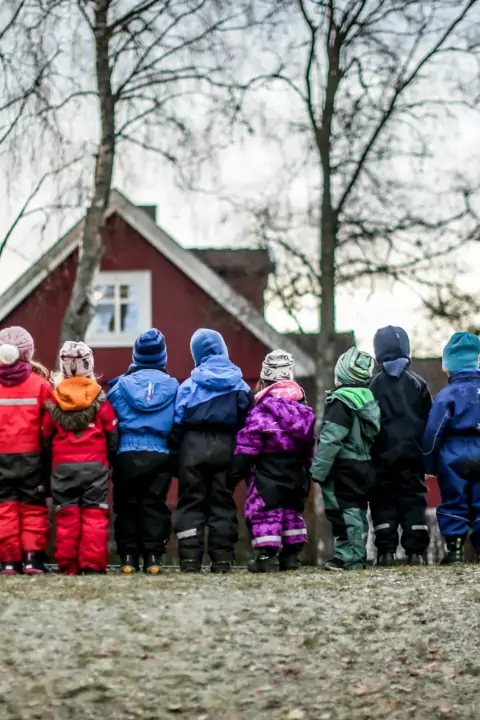
In the U.S., comparable full-time childcare can cost $1,351–$2,703 per child. The difference is like night and day. Daycare centers are play-based, spend a lot of time outdoors (regardless of the weather), and focus on friendship, creativity, and resilience. “Outdoor preschools” with campfires, tree climbing, and rubber boots year-round are quite common. Many expats say this is the reason they stay.
School, parental leave, and upbringing
Public schools are free and of high quality – from preschool to university. No pressure to perform as in many other countries, plenty of breaks (recess), and a focus on well-being and cooperation. International schools are available for expats, but they cost more.
Parental leave is among the best in the world: Up to 49 weeks at nearly full pay or 59 weeks at 80%. It is shared between the mother and father, and the paternity quota is actually used. Many foreign parents are speechless: “Both parents get time to bond with the child without going broke?” Yes. Plus child benefit of around $180 per child per month until they turn 18.
Parenting here is about equality, outdoor life, and trust. Children are allowed to walk to school alone at an early age, play outside until dark, and learn that it’s okay to make mistakes. Dads are equally involved. The dark season can be challenging, but cabin trips, cozy time together, and community work create a closeness that many miss elsewhere.
Vacation: Five weeks plus holidays – and we use them!
Norwegians have at least five weeks of vacation a year. Many take three to four consecutive weeks in the summer. Cabin trips, mountain hikes, camping in the woods, or trips to the south. Domestic vacations can be surprisingly affordable if you choose a cabin, barbecuing, and swimming in the fjord.
International flights can also be affordable with a little planning.
It’s all about “koselig” – that Norwegian sense of warmth, coziness, and togetherness that’s “impossible” to translate into other languages. An evening by the fireplace with friends and waffles after a rainy hike beats most expensive restaurants.
Is it worth it, then?
If you earn a typical Norwegian salary, then yes – it’s definitely worth it for most people. High taxes (30–40%) fund security: You don’t need to save up a fortune in case of illness or unemployment. Your children get a childhood filled with plenty of freedom and nature. You yourself get time for life outside of work.
There are definitely challenges: the winter darkness, a somewhat reserved population at first (we warm up eventually), and the fact that everything costs a pretty penny. But after a few years, many say the same thing: “I no longer notice that it’s expensive – I just think about how good life is here.”
Norway isn’t cheap. But it certainly doesn’t feel like a waste. It’s like a ticket to a place where society actually works, nature is magical, and children can grow up without their parents going through the roof with stress.
If you make the trip! Bring good waterproof boots, an open mind, and maybe a little patience with the weather.
We have fjords, the midnight sun, and a welfare state that actually cares. The rest will work itself out.
Life In Norway Cross-Cultural